The Whisper Map of East Ridge: A Carved Stone That Reveals Hidden Places
The Whisper Map of East Ridge: A Carved Stone That Reveals Hidden Places
Introduction: A Map That Doesn’t Like Being Read Aloud
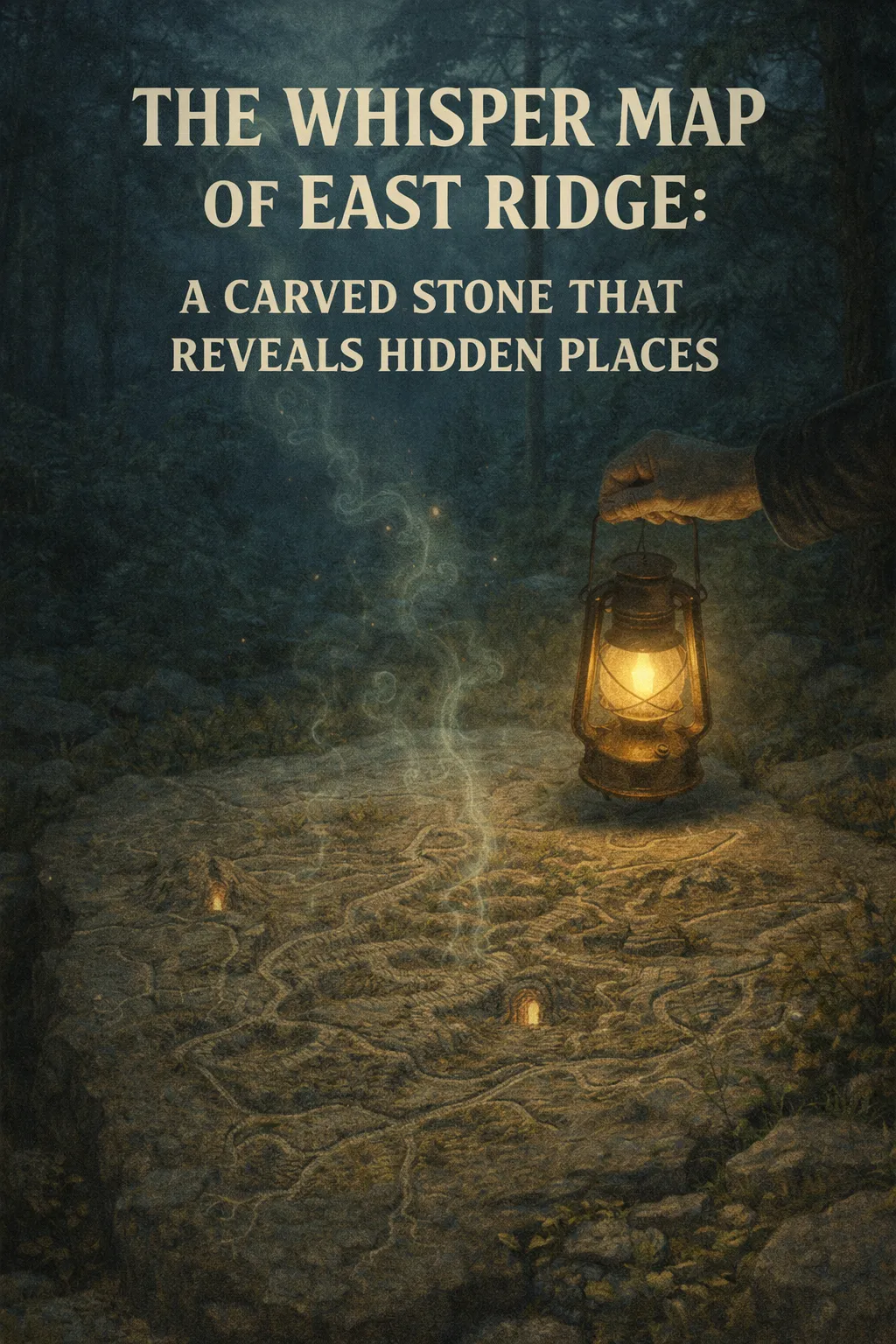
In a wooded ravine near East Ridge, Tennessee, there is a flat stone locals avoid touching. It looks ordinary at first—weathered limestone, half-buried, streaked with lichen. But when rain falls just right, faint carvings emerge on its surface.
Lines.
Symbols.
Paths that don’t exist on any modern map.
And then the stone begins to whisper.
Not loudly.
Not clearly.
Just enough to make you lean closer.
They call it The Whisper Map—a carved stone said to reveal hidden places across East Ridge and the surrounding Chattanooga Valley. Places that no longer appear on maps. Places that were never meant to be found again.
The Stone No One Could Explain
The Whisper Map was first documented in 1924 by a surveyor named Harold McRae, who noticed unusual markings on a stone while mapping property lines near the Georgia–Tennessee border.
His notes describe:
“A flattened rock with grooves that align only when wet. When water runs across it, the markings form a layout—roads, bends, and structures that do not exist.”
McRae returned multiple times, attempting to trace the lines onto paper. Each time, the pattern appeared slightly different.
And then he stopped coming back.
What the Map Shows—When It Chooses To
Those who have seen the stone during rainfall describe a shifting layout that resembles:
Old wagon roads that no longer exist
Buildings that never appear on official records
Circles are believed to mark burial grounds or meeting sites
River bends that don’t match the modern Tennessee River
Stair-like carvings that seem to descend into the stone
Some claim the map changes depending on who is watching.
Others insist it only reveals what the viewer is looking for.
The Whispers: Directions You Shouldn’t Follow
The map earned its name because of what happens when people linger.
Witnesses report:
Low murmuring that sounds like breath across gravel
Words that never quite form—but feel understood
A sensation of being “guided.”
Pressure behind the ears
The urge to follow one specific carved line
Those who resist the urge often describe headaches and nausea.
Those who follow it sometimes don’t come back the same.
Eyewitness Encounters That Raised Alarms
The Teen Explorers (1958)
Two teens followed a carved path that appeared after a storm. They reached a clearing neither could later relocate.
One returned shaken.
The other returned silently and refused to speak of the experience.
The Hiker’s Journal (1986)
A solo hiker recorded finding stone steps carved into a hillside where the map indicated a “drop.” The steps led nowhere, ending abruptly in solid rock.
He wrote one final entry:
“The map didn’t lead me somewhere. It showed me where something used to be.”
The Property Developer (2003)
A developer attempted to remove the stone during land clearing. The equipment failed repeatedly. Workers complained of hearing voices directing them away from the site.
The stone was left where it lay.
Theories Behind the Whisper Map
1. A Cherokee Memory Stone
Cherokee traditions speak of “talking stones”—markers that record paths, places, and warnings through carving and sound.
Some believe the Whisper Map preserves locations lost during forced removal, revealing sacred places only when the land decides it’s safe.
2. A Living Map of the Past
Paranormal researchers suggest the stone may function as a temporal overlay, revealing past geography rather than present.
This would explain why some paths lead to empty forest… and others to places that feel unnervingly occupied.
3. A Gateway Index
The darkest theory claims the map doesn’t show places—it shows access points.
Not destinations.
Entrances.
4. Psychological Projection
Skeptics argue the whispers are auditory pareidolia and the map a trick of water and imagination.
But imagination doesn’t move people miles off trail…
and it doesn’t erase GPS signals.
Strange Patterns Surrounding the Stone
Locals have noticed:
The map appears only after rain
The carvings glow faintly at dusk
Moss never grows inside the grooves
Compasses spin when held over the center
Animals avoid the area entirely
People feel compelled to kneel near the stone
Most unsettling of all:
Some claim the map adds new lines after nearby construction or destruction.
As if updating itself.
Places the Map Is Said to Reveal
According to collected accounts, the Whisper Map has pointed toward:
A sealed tunnel beneath East Ridge
A vanished settlement near the Georgia line
A buried stone circle is no longer visible
A forgotten cemetery without markers
A stairway carved into bedrock that no longer exists
None of these locations appears on modern maps.
Yet some have been independently confirmed.
Top 5 Map-Based Paranormal Legends in Tennessee
The Whisper Map of East Ridge – A stone that reveals hidden places
The Blurred Cemetery of Birchwood – Headstones that rewrite themselves
The Time Echoes of Red Bank – Footsteps that arrive early
The Vanishing Ferry of the Tennessee River – Passengers from another time
The Mirror Man of Mountain Creek – Reflections that move on their own
Should You Seek Out the Whisper Map?
Locals advise caution.
If You Encounter It:
Don’t trace the carvings with your finger
Don’t read the lines aloud
Don’t follow paths that appear suddenly
Leave if you feel dizzy or disoriented
Never attempt to move the stone
One rule above all others:
If the map seems to be responding to you… it’s time to go.
Conclusion: Not All Maps Lead Forward
The Whisper Map of East Ridge isn’t a guide—it’s a reminder. A reminder that the land remembers what people erase. Those paths don’t disappear simply because we stop walking them.
Some places don’t want to be found again.
Some doors were closed for a reason.
And some maps don’t show where you’re going…
They show where you shouldn’t return.
